A sign-up form with no offer behind it converts at roughly 2%. Add a lead magnet and that number jumps to 6.5%. That’s 325% more subscribers. That’s not a small lift. It’s the difference between building a list slowly and building one that grows every time someone lands on your page.
Most small businesses skip lead magnets because they think it means writing an ebook. It doesn’t. A lead magnet is anything valuable enough that a visitor will trade their email address for it: a discount, a checklist, a template, a quiz result, a free trial. The format matters less than the fit. The right offer for your business is the one your specific audience would actually use.
The harder question isn’t whether to use a lead magnet. It’s which format will work for your business and your audience. That’s what this post is about.
What makes a lead magnet effective?
A lead magnet works when it delivers value in the same session the subscriber signs up. Not tomorrow. Not when they find time to read. Now.
Alexandra Franzen, an author and longtime AWeber customer who built her business entirely without social media, describes the goal of every email interaction as “delivering a little miracle to their inbox.”
That framing is a useful test for any lead magnet you’re considering. Can someone use this in the next 30 minutes? Does it solve something specific they were already trying to solve? If yes, you have a lead magnet worth building. If it requires carving out time they don’t have, reconsider the format.
The formats below are grouped by type. Within each group, faster-to-use formats come first.
Deals and offers
These are the fastest-converting lead magnets for businesses where price is part of the decision. No reading required. No download to open.
Discounts and coupons
Who this works for: Ecommerce businesses, retailers, restaurants, service businesses with a fixed-price menu.
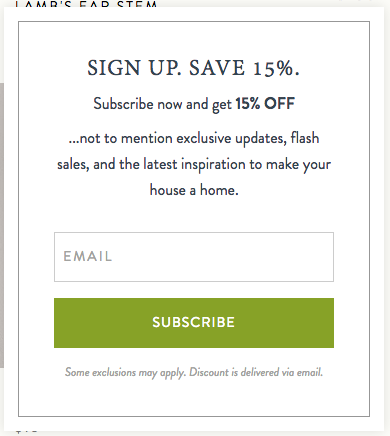
A discount is a lead magnet. “Get 15% off your first order when you join our list” is a sign-up incentive with immediate, measurable value. The subscriber gets something they can use today. You get an email address attached to purchase intent.
Why it works: The value is concrete and usable right now. There’s no gap between subscribing and receiving the benefit.
Example: A local coffee shop offers a free drink on your next visit when you join their list. A clothing retailer offers 20% off a first purchase. Both convert at the moment of highest intent: when someone is already on the site and considering a purchase.
Giveaways and contests
Who this works for: Retail, ecommerce, consumer brands, local businesses building audience quickly.
A giveaway offers a prize in exchange for an email address, with bonus entries for sharing. The format builds lists fast. It also builds lists with variable quality. People who entered to win a prize are not the same as people who signed up because they want what you sell. The prize should be something your ideal customer wants, not something anyone would enter to win.
Why it works: The sharing mechanic extends reach organically. A well-designed giveaway can grow a list significantly in a short window, especially when promoted on social media.
Example: A fitness studio gives away a free month of classes. A home goods brand gives away a product bundle. In both cases, every entrant is a qualified lead because the prize only appeals to people who already want what the business sells.
Free trials and demos
Who this works for: SaaS businesses, subscription products, service businesses with a defined scope of work.
A free trial or demo is a lead magnet where the product itself is the offer. The subscriber doesn’t download anything. They experience the thing directly. For software and subscription products, a trial subscriber is substantially more likely to convert than a cold lead who received an ebook.
Why it works: The barrier to entry is low and the trust signal is high. Offering a free trial says you’re confident enough in what you sell to let someone try it before paying.
Example: A project management tool offers a 14-day free trial. A marketing consultant offers a free 30-minute strategy call. Both get an email address attached to someone who has already expressed real interest.
High value, ready-to-use resources
These formats deliver something a subscriber can put to work immediately. They consistently outperform knowledge-based formats in welcome email engagement.
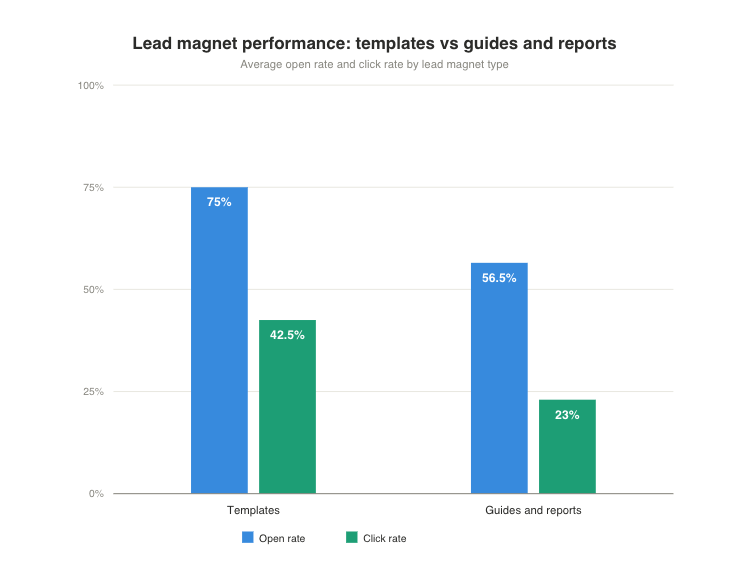
In AWeber’s data across 42,000+ welcome email sends, template-based lead magnets averaged a 75% open rate and 42.5% click rate, compared to 56.5% opens and 23% clicks for guides and reports. (See what 42,000+ welcome emails taught me about lead magnet strategy for the full breakdown.)
Templates
Who this works for: Any business where subscribers have a specific task to complete: writing, planning, organizing, designing, presenting.
When someone downloads a template, they are not signing up to learn something later. They are signing up to use something now. The welcome email is a fulfillment email. The expectation was set. The item is ready. Open and collect.
Why it works: AWeber’s email marketing planning template produced a 76% open rate and 47% click rate across 3,000+ sends. The 45-email templates offer produced 74% opens and 38% clicks across 28,700+ sends. A template that saves someone 20 minutes on a task they were already going to do is worth more to them than a 30-page guide on the same topic.
Example: A social media manager offers a month of caption templates. A financial coach offers a budget spreadsheet. A wedding photographer offers a shot list template for couples to fill in before the session.
Checklists and cheat sheets
Who this works for: Almost every small business category: coaches, consultants, service providers, retailers, health and wellness, home services.
A one-page checklist takes two hours to create and two minutes to use. An ebook on the same topic takes days to write and hours to read. The best checklists are decision support tools. Each item is actionable. Each item removes a decision the subscriber would otherwise have to make on their own.
Why it works: A checklist demonstrates expertise without requiring the subscriber to sit through a course. Every item signals that you understand their situation.
Example: “10 things to check before launching a website.” “What to do the week before an event.” “The questions to ask when hiring a photographer.” Simple, specific, and immediately useful.
Workbooks and worksheets
Who this works for: Coaches, educators, consultants, health and wellness businesses, anyone who guides subscribers through a process or decision.
A workbook is a checklist with prompts. Instead of “here are the things to do,” it says “here is a structured space to work through this.” The subscriber fills it in, which means they actively engage with your framework rather than passively reading it.
Why it works: A well-designed 8-to-10-page PDF that walks someone through a planning exercise can be built in a day. It delivers the kind of structured thinking subscribers would otherwise pay for in a session with a coach or consultant.
Example: A business coach offers a 90-day goal-setting workbook. A therapist offers a weekly check-in worksheet. A nutritionist offers a meal planning workbook.
Resource lists and toolkits
Who this works for: Coaches, consultants, educators, service providers, bloggers. Any business where subscribers are trying to figure out what tools, resources, or services to use.
A curated resource list saves someone the research they were about to do anyway. You’ve already done the work. They get the shortcut. The key is curation, not comprehensiveness. A list of 50 tools is not twice as good as a list of 25. Keep it tight, keep it opinionated, and explain briefly why each item made the cut.
Why it works: Specificity is the value. A generic list of “marketing tools” is easy to ignore. “The seven tools I use to run my one-person consulting business” is something people save and share.
Example: “The apps every bakery owner should know.” “My go-to vendors for event planning.” “The exact tools I use to run a remote team of five.”
Interactive and educational formats
These formats take longer to consume than a checklist or template, but they build a different kind of relationship. The subscriber invests more time, which typically means more trust by the time the sequence ends.
Quizzes and assessments
Who this works for: Coaches, consultants, educators, health and wellness businesses, service businesses where the right solution depends on the subscriber’s situation.
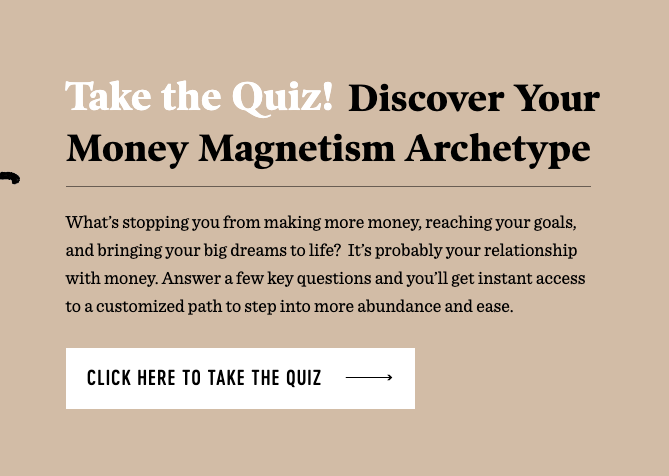
A quiz converts well because it promises personalization. Instead of “here is a thing for everyone,” it says “here is something based on your specific answers.” Assessment results also give you segmentation data from the moment someone joins your list. You don’t have to guess what they need. They already told you.
Why it works: The opt-in prompt is stronger because the subscriber believes the result will be relevant to them specifically. Quiz lead magnets convert between 20% and 40% depending on how personalized the experience feels.
Example: A financial coach offers “What’s your money personality?” A personal trainer offers “What’s your fitness starting point?” A marketing consultant offers “Which content type fits your business?”
Challenges
Who this works for: Fitness, wellness, productivity, creative, education, and any business where behavior change is part of what you sell.
A challenge is a multi-day commitment: a 5-day writing challenge, a 7-day meal prep challenge, a 30-day fitness habit. The subscriber opts in knowing they’re signing up for a structured experience over time. Challenges also filter for motivation. Someone who signs up for a 30-day challenge is signaling they’re serious.
Why it works: Participants often share their progress publicly, which extends reach without additional cost. A challenge generates both list growth and social proof simultaneously.
Example: A yoga instructor runs a 7-day morning movement challenge. A copywriter runs a 5-day email writing challenge. Each daily email builds the relationship before any offer is made.
Mini-courses delivered by email
Who this works for: Educators, coaches, consultants, anyone who teaches a skill or methodology.
A five-day email course is a lead magnet that doubles as a nurture sequence. Each email delivers one lesson. Subscribers opt in knowing they’re signing up for a series, which sets engagement expectations from the start. A subscriber who completes your email course has spent five days reading your perspective and trusting your framing.
Why it works: It turns a passive subscriber into an active learner. By the time the course ends, they’re more likely to take the next step than someone who downloaded a PDF and moved on. Each lesson also gives the subscriber a reason to open the next email.
Example: A business coach offers “5 days to your first paying client.” A graphic designer offers “Learn Canva in 5 emails.” Each lesson is short, useful, and ends with one action to take before the next email arrives.
In-depth content
These formats work best when the subscriber is in research mode: evaluating options, building knowledge, preparing to make a decision.
Guides, reports, and ebooks
Who this works for: Businesses targeting subscribers in research mode: high-consideration purchases, B2B audiences, industries where the subscriber needs context before making a decision.
Guides and reports are the most common lead magnet format and, in most cases, not the fastest-converting one.
AWeber’s data across 4,900+ sends of a small business email marketing report showed a 54% open rate and 21% click rate in the welcome email. The 5,100+ sends of a landing page guide came in at 59% opens and 25% clicks. Someone subscribes for a guide when they want to learn something eventually. The urgency is lower. The “I’ll get to this later” impulse is higher.
Why it works: A guide works when it contains data or a framework subscribers genuinely cannot find anywhere else. Specificity is what separates a guide people finish from one they bookmark and forget.
Example: A recruiting firm publishes “The 2026 Salary Guide for Tech Roles.” An accountant offers “The Small Business Tax Prep Checklist.” Both offer information with enough depth and specificity that the subscriber can’t easily find it elsewhere.
How to deliver your lead magnet using AWeber
Every format above delivers through the same core setup: a landing page, a sign-up form, and an automated welcome email. In AWeber, you can build all three without touching code.
Step 1: Build your landing page. This is the page where visitors trade their email for your offer. Keep it focused. One offer, one form, one action.
Step 2: Create your sign-up form. Ask for email only unless you have a strong reason for more. Each additional field reduces conversions. Tag new subscribers based on which form they used so you know which lead magnet brought them in.
Step 3: Apply tags. Use the tag applied at sign-up to route subscribers into the right follow-up sequence. Someone who downloaded a beginner checklist should get different follow-up than someone who signed up for an advanced course. AWeber’s workflow automations let you build those paths visually without any technical setup.
Step 4: Set up your welcome email automation. The moment someone subscribes, an automation triggers and delivers the offer. For a PDF, link directly to the file. For a discount code, include it in the email body. For a challenge or mini-course, this first email is day one. The setup takes less than 20 minutes and runs automatically from that point forward.
What makes a lead magnet convert?
Conversion rates for lead magnets range from 5% to 35% depending on the offer. The gap isn’t luck. The highest-converting lead magnets tend to share the same four traits.
Solve one specific problem. “10 Marketing Tips” is a topic. “5-Minute Email Template That Books Discovery Calls” is a lead magnet. Specificity is what makes someone think: that’s exactly what I need right now.
Demonstrate your unique process. The best lead magnets give prospects a taste of what working with you actually looks like. A template built around your framework. A checklist that reflects how you think. That’s harder to find elsewhere and harder to ignore.
Require minimal time investment. The faster someone gets value, the more likely they are to open the welcome email, use the offer, and trust what you send next. A one-page checklist beats a 20-page guide for most audiences at most stages.
Match your paid offering’s value level. A $5,000 consulting service needs a more substantial lead magnet than a $29 course. The offer signals what kind of relationship you’re inviting someone into. If the lead magnet feels thin relative to what you sell, the gap creates doubt rather than trust.
How to choose the right lead magnet
The best lead magnet is the one that attracts the subscriber most likely to buy from you, not the one with the highest raw sign-up volume.
Solve one specific problem. A lead magnet that tries to help everyone helps no one. “Email marketing for small businesses” is a topic. “A checklist for writing your first welcome email” is a lead magnet.
Match the format to what the subscriber is trying to do right now. Someone preparing to launch a product needs a checklist or template. Someone evaluating whether to hire a coach needs an assessment. Someone who just discovered your brand and wants to save money needs a discount code. The format follows the intent.
Build for immediate use, not eventual learning. The closer your lead magnet is to something the subscriber can use in the next 30 minutes, the higher your welcome email click rate will be. Templates, checklists, workbooks, and discount codes all satisfy an immediate need. Guides and courses require time the subscriber rarely has.
Use your lead magnet as a segmentation signal. Tag subscribers by the offer they chose. That tag tells you what the subscriber was trying to accomplish when they joined, and you can use it to send follow-up content that matches their intent rather than generic broadcasts.
FAQ
What is the best lead magnet for a service business?
For service businesses, a checklist or assessment is usually the strongest starting point. Something like “10 questions to ask before hiring a [type of provider]” positions you as the expert while giving the subscriber something useful right now. It also works as pre-qualification. Someone who downloads your hiring checklist is actively looking for the service you provide. Ebooks tend to underperform for service businesses because the purchase decision is relationship-based, not information-based.
What is the best lead magnet for an ecommerce business?
For ecommerce, a discount or first-purchase offer is usually the highest-converting starting point. The value is immediate and concrete. The subscriber doesn’t have to read anything. They save money on something they were already considering buying. If you want to build a list of engaged readers in addition to discount-motivated buyers, pair the offer with a short welcome sequence that introduces your brand and products.
Should I use one lead magnet or multiple?
Start with one. A single well-matched lead magnet produces cleaner data and simpler delivery than multiple competing offers. Once you’ve validated that one offer converts and that subscribers who download it behave the way you want, add a second offer targeting a different segment. If you do run multiple lead magnets, tag subscribers by which offer they chose so you can send follow-up content that matches their intent.
Does a discount count as a lead magnet?
Yes. A discount, free shipping offer, or first-purchase incentive is a lead magnet. It exchanges value for an email address the same way a checklist or template does. For ecommerce and retail businesses, it often outperforms content-based lead magnets because the value is immediate and concrete.
What is the difference between a lead magnet and an opt-in incentive?
They are the same thing. Lead magnet, opt-in incentive, content upgrade, and sign-up offer all describe the same exchange: you give something of value, the visitor gives you their email address. The format and quality of what you offer matter far more than what you call it.
Sean Tinney is a content marketer at AWeber with 15+ years working directly with small business owners on email strategy, list building, and automation. He focuses on what actually moves the needle for businesses without large marketing teams.Connect with Sean on LinkedIn
A sign-up form with no offer behind it converts at roughly 2%. Add a lead magnet and that number jumps to 6.5%. That’s 325% more subscribers. That’s not a small lift. It’s the difference between building a list slowly and building one that grows every time someone lands on your page.

Most small businesses skip lead magnets because they think it means writing an ebook. It doesn’t. A lead magnet is anything valuable enough that a visitor will trade their email address for it: a discount, a checklist, a template, a quiz result, a free trial. The format matters less than the fit. The right offer for your business is the one your specific audience would actually use.

The harder question isn’t whether to use a lead magnet. It’s which format will work for your business and your audience. That’s what this post is about.

What makes a lead magnet effective?

A lead magnet works when it delivers value in the same session the subscriber signs up. Not tomorrow. Not when they find time to read. Now.

Alexandra Franzen, an author and longtime AWeber customer who built her business entirely without social media, describes the goal of every email interaction as “delivering a little miracle to their inbox.”

That framing is a useful test for any lead magnet you’re considering. Can someone use this in the next 30 minutes? Does it solve something specific they were already trying to solve? If yes, you have a lead magnet worth building. If it requires carving out time they don’t have, reconsider the format.

The formats below are grouped by type. Within each group, faster-to-use formats come first.

Deals and offers

These are the fastest-converting lead magnets for businesses where price is part of the decision. No reading required. No download to open.

Discounts and coupons

Who this works for: Ecommerce businesses, retailers, restaurants, service businesses with a fixed-price menu.

A discount is a lead magnet. “Get 15% off your first order when you join our list” is a sign-up incentive with immediate, measurable value. The subscriber gets something they can use today. You get an email address attached to purchase intent.

Why it works: The value is concrete and usable right now. There’s no gap between subscribing and receiving the benefit.

Example: A local coffee shop offers a free drink on your next visit when you join their list. A clothing retailer offers 20% off a first purchase. Both convert at the moment of highest intent: when someone is already on the site and considering a purchase.

Giveaways and contests

Who this works for: Retail, ecommerce, consumer brands, local businesses building audience quickly.

A giveaway offers a prize in exchange for an email address, with bonus entries for sharing. The format builds lists fast. It also builds lists with variable quality. People who entered to win a prize are not the same as people who signed up because they want what you sell. The prize should be something your ideal customer wants, not something anyone would enter to win.

Why it works: The sharing mechanic extends reach organically. A well-designed giveaway can grow a list significantly in a short window, especially when promoted on social media.

Example: A fitness studio gives away a free month of classes. A home goods brand gives away a product bundle. In both cases, every entrant is a qualified lead because the prize only appeals to people who already want what the business sells.

Free trials and demos

Who this works for: SaaS businesses, subscription products, service businesses with a defined scope of work.

A free trial or demo is a lead magnet where the product itself is the offer. The subscriber doesn’t download anything. They experience the thing directly. For software and subscription products, a trial subscriber is substantially more likely to convert than a cold lead who received an ebook.

Why it works: The barrier to entry is low and the trust signal is high. Offering a free trial says you’re confident enough in what you sell to let someone try it before paying.

Example: A project management tool offers a 14-day free trial. A marketing consultant offers a free 30-minute strategy call. Both get an email address attached to someone who has already expressed real interest.

High value, ready-to-use resources

These formats deliver something a subscriber can put to work immediately. They consistently outperform knowledge-based formats in welcome email engagement.

In AWeber’s data across 42,000+ welcome email sends, template-based lead magnets averaged a 75% open rate and 42.5% click rate, compared to 56.5% opens and 23% clicks for guides and reports. (See what 42,000+ welcome emails taught me about lead magnet strategy for the full breakdown.)

Templates

Who this works for: Any business where subscribers have a specific task to complete: writing, planning, organizing, designing, presenting.

When someone downloads a template, they are not signing up to learn something later. They are signing up to use something now. The welcome email is a fulfillment email. The expectation was set. The item is ready. Open and collect.

Why it works: AWeber’s email marketing planning template produced a 76% open rate and 47% click rate across 3,000+ sends. The 45-email templates offer produced 74% opens and 38% clicks across 28,700+ sends. A template that saves someone 20 minutes on a task they were already going to do is worth more to them than a 30-page guide on the same topic.

Example: A social media manager offers a month of caption templates. A financial coach offers a budget spreadsheet. A wedding photographer offers a shot list template for couples to fill in before the session.

Checklists and cheat sheets

Who this works for: Almost every small business category: coaches, consultants, service providers, retailers, health and wellness, home services.

A one-page checklist takes two hours to create and two minutes to use. An ebook on the same topic takes days to write and hours to read. The best checklists are decision support tools. Each item is actionable. Each item removes a decision the subscriber would otherwise have to make on their own.

Why it works: A checklist demonstrates expertise without requiring the subscriber to sit through a course. Every item signals that you understand their situation.

Example: “10 things to check before launching a website.” “What to do the week before an event.” “The questions to ask when hiring a photographer.” Simple, specific, and immediately useful.

Workbooks and worksheets

Who this works for: Coaches, educators, consultants, health and wellness businesses, anyone who guides subscribers through a process or decision.

A workbook is a checklist with prompts. Instead of “here are the things to do,” it says “here is a structured space to work through this.” The subscriber fills it in, which means they actively engage with your framework rather than passively reading it.

Why it works: A well-designed 8-to-10-page PDF that walks someone through a planning exercise can be built in a day. It delivers the kind of structured thinking subscribers would otherwise pay for in a session with a coach or consultant.

Example: A business coach offers a 90-day goal-setting workbook. A therapist offers a weekly check-in worksheet. A nutritionist offers a meal planning workbook.

Resource lists and toolkits

Who this works for: Coaches, consultants, educators, service providers, bloggers. Any business where subscribers are trying to figure out what tools, resources, or services to use.

A curated resource list saves someone the research they were about to do anyway. You’ve already done the work. They get the shortcut. The key is curation, not comprehensiveness. A list of 50 tools is not twice as good as a list of 25. Keep it tight, keep it opinionated, and explain briefly why each item made the cut.

Why it works: Specificity is the value. A generic list of “marketing tools” is easy to ignore. “The seven tools I use to run my one-person consulting business” is something people save and share.

Example: “The apps every bakery owner should know.” “My go-to vendors for event planning.” “The exact tools I use to run a remote team of five.”

Interactive and educational formats

These formats take longer to consume than a checklist or template, but they build a different kind of relationship. The subscriber invests more time, which typically means more trust by the time the sequence ends.

Quizzes and assessments

Who this works for: Coaches, consultants, educators, health and wellness businesses, service businesses where the right solution depends on the subscriber’s situation.

A quiz converts well because it promises personalization. Instead of “here is a thing for everyone,” it says “here is something based on your specific answers.” Assessment results also give you segmentation data from the moment someone joins your list. You don’t have to guess what they need. They already told you.

Why it works: The opt-in prompt is stronger because the subscriber believes the result will be relevant to them specifically. Quiz lead magnets convert between 20% and 40% depending on how personalized the experience feels.

Example: A financial coach offers “What’s your money personality?” A personal trainer offers “What’s your fitness starting point?” A marketing consultant offers “Which content type fits your business?”

Challenges

Who this works for: Fitness, wellness, productivity, creative, education, and any business where behavior change is part of what you sell.

A challenge is a multi-day commitment: a 5-day writing challenge, a 7-day meal prep challenge, a 30-day fitness habit. The subscriber opts in knowing they’re signing up for a structured experience over time. Challenges also filter for motivation. Someone who signs up for a 30-day challenge is signaling they’re serious.

Why it works: Participants often share their progress publicly, which extends reach without additional cost. A challenge generates both list growth and social proof simultaneously.

Example: A yoga instructor runs a 7-day morning movement challenge. A copywriter runs a 5-day email writing challenge. Each daily email builds the relationship before any offer is made.

Mini-courses delivered by email

Who this works for: Educators, coaches, consultants, anyone who teaches a skill or methodology.

A five-day email course is a lead magnet that doubles as a nurture sequence. Each email delivers one lesson. Subscribers opt in knowing they’re signing up for a series, which sets engagement expectations from the start. A subscriber who completes your email course has spent five days reading your perspective and trusting your framing.

Why it works: It turns a passive subscriber into an active learner. By the time the course ends, they’re more likely to take the next step than someone who downloaded a PDF and moved on. Each lesson also gives the subscriber a reason to open the next email.

Example: A business coach offers “5 days to your first paying client.” A graphic designer offers “Learn Canva in 5 emails.” Each lesson is short, useful, and ends with one action to take before the next email arrives.

In-depth content

These formats work best when the subscriber is in research mode: evaluating options, building knowledge, preparing to make a decision.

Guides, reports, and ebooks

Who this works for: Businesses targeting subscribers in research mode: high-consideration purchases, B2B audiences, industries where the subscriber needs context before making a decision.

Guides and reports are the most common lead magnet format and, in most cases, not the fastest-converting one.

AWeber’s data across 4,900+ sends of a small business email marketing report showed a 54% open rate and 21% click rate in the welcome email. The 5,100+ sends of a landing page guide came in at 59% opens and 25% clicks. Someone subscribes for a guide when they want to learn something eventually. The urgency is lower. The “I’ll get to this later” impulse is higher.

Why it works: A guide works when it contains data or a framework subscribers genuinely cannot find anywhere else. Specificity is what separates a guide people finish from one they bookmark and forget.

Example: A recruiting firm publishes “The 2026 Salary Guide for Tech Roles.” An accountant offers “The Small Business Tax Prep Checklist.” Both offer information with enough depth and specificity that the subscriber can’t easily find it elsewhere.

How to deliver your lead magnet using AWeber

Every format above delivers through the same core setup: a landing page, a sign-up form, and an automated welcome email. In AWeber, you can build all three without touching code.

Step 1: Build your landing page. This is the page where visitors trade their email for your offer. Keep it focused. One offer, one form, one action.

Step 2: Create your sign-up form. Ask for email only unless you have a strong reason for more. Each additional field reduces conversions. Tag new subscribers based on which form they used so you know which lead magnet brought them in.

Step 3: Apply tags. Use the tag applied at sign-up to route subscribers into the right follow-up sequence. Someone who downloaded a beginner checklist should get different follow-up than someone who signed up for an advanced course. AWeber’s workflow automations let you build those paths visually without any technical setup.

Step 4: Set up your welcome email automation. The moment someone subscribes, an automation triggers and delivers the offer. For a PDF, link directly to the file. For a discount code, include it in the email body. For a challenge or mini-course, this first email is day one. The setup takes less than 20 minutes and runs automatically from that point forward.

What makes a lead magnet convert?

Conversion rates for lead magnets range from 5% to 35% depending on the offer. The gap isn’t luck. The highest-converting lead magnets tend to share the same four traits.

Solve one specific problem. “10 Marketing Tips” is a topic. “5-Minute Email Template That Books Discovery Calls” is a lead magnet. Specificity is what makes someone think: that’s exactly what I need right now.

Demonstrate your unique process. The best lead magnets give prospects a taste of what working with you actually looks like. A template built around your framework. A checklist that reflects how you think. That’s harder to find elsewhere and harder to ignore.

Require minimal time investment. The faster someone gets value, the more likely they are to open the welcome email, use the offer, and trust what you send next. A one-page checklist beats a 20-page guide for most audiences at most stages.

Match your paid offering’s value level. A $5,000 consulting service needs a more substantial lead magnet than a $29 course. The offer signals what kind of relationship you’re inviting someone into. If the lead magnet feels thin relative to what you sell, the gap creates doubt rather than trust.

How to choose the right lead magnet

The best lead magnet is the one that attracts the subscriber most likely to buy from you, not the one with the highest raw sign-up volume.

Solve one specific problem. A lead magnet that tries to help everyone helps no one. “Email marketing for small businesses” is a topic. “A checklist for writing your first welcome email” is a lead magnet.

Match the format to what the subscriber is trying to do right now. Someone preparing to launch a product needs a checklist or template. Someone evaluating whether to hire a coach needs an assessment. Someone who just discovered your brand and wants to save money needs a discount code. The format follows the intent.

Build for immediate use, not eventual learning. The closer your lead magnet is to something the subscriber can use in the next 30 minutes, the higher your welcome email click rate will be. Templates, checklists, workbooks, and discount codes all satisfy an immediate need. Guides and courses require time the subscriber rarely has.

Use your lead magnet as a segmentation signal. Tag subscribers by the offer they chose. That tag tells you what the subscriber was trying to accomplish when they joined, and you can use it to send follow-up content that matches their intent rather than generic broadcasts.

FAQ


    What is the best lead magnet for a service business?

      For service businesses, a checklist or assessment is usually the strongest starting point. Something like “10 questions to ask before hiring a [type of provider]” positions you as the expert while giving the subscriber something useful right now. It also works as pre-qualification. Someone who downloads your hiring checklist is actively looking for the service you provide. Ebooks tend to underperform for service businesses because the purchase decision is relationship-based, not information-based.


    What is the best lead magnet for an ecommerce business?

      For ecommerce, a discount or first-purchase offer is usually the highest-converting starting point. The value is immediate and concrete. The subscriber doesn’t have to read anything. They save money on something they were already considering buying. If you want to build a list of engaged readers in addition to discount-motivated buyers, pair the offer with a short welcome sequence that introduces your brand and products.


    Should I use one lead magnet or multiple?

      Start with one. A single well-matched lead magnet produces cleaner data and simpler delivery than multiple competing offers. Once you’ve validated that one offer converts and that subscribers who download it behave the way you want, add a second offer targeting a different segment. If you do run multiple lead magnets, tag subscribers by which offer they chose so you can send follow-up content that matches their intent.


    Does a discount count as a lead magnet?

      Yes. A discount, free shipping offer, or first-purchase incentive is a lead magnet. It exchanges value for an email address the same way a checklist or template does. For ecommerce and retail businesses, it often outperforms content-based lead magnets because the value is immediate and concrete.


    What is the difference between a lead magnet and an opt-in incentive?

      They are the same thing. Lead magnet, opt-in incentive, content upgrade, and sign-up offer all describe the same exchange: you give something of value, the visitor gives you their email address. The format and quality of what you offer matter far more than what you call it.


Keep reading:

How to create a lead magnet in less than a day (that actually works)

What Are Lead Magnets? Types, Strategies, and the Best Examples

Sean Tinney is a content marketer at AWeber with 15+ years working directly with small business owners on email strategy, list building, and automation. He focuses on what actually moves the needle for businesses without large marketing teams. Connect with Sean on LinkedInSean Tinney
 87% off ends soon!